The Four Core Sizing Calculations
Building a reliable off-grid solar system is an exact engineering process. Unlike a grid-connected system where an undersized array simply draws shortfall energy from the poles and wires, an undersized off-grid system shuts down, leaves your family in the dark, and trips water pumps midway through livestock watering cycles.
Too many online sizing calculators rely on simple guesswork or generic national averages. Sizing a stand-alone power system for a Queensland property requires calculating four interdependent variables in sequence:
- Daily Energy Consumption: The total kilowatt-hours (kWh) consumed over twenty-four hours.
- Peak Inverter Surge: The maximum concurrent wattage and motor starting currents.
- Usable Battery Storage: The kilowatt-hours required to carry critical loads through dark hours and cloudy days.
- Solar Array Capacity: The panel wattage needed to run daytime loads and fully recharge depleted batteries during the shortest winter days.
Step 1: Daily Energy Audit (kWh)
The first step in off-grid engineering is an honest load profile audit. According to the Australian Energy Regulator (AER) residential benchmarks, a standard grid-connected Queensland home consumes roughly 15 kWh per day. However, on working rural properties, hobby farms, and acreage estates, daily energy consumption frequently ranges between 25 kWh and 60 kWh per day due to water pressure systems, refrigeration, workshops, and air conditioning.
To perform an accurate audit, compile every electrical load into three categories:
- Continuous Baseloads: Appliances running twenty-four hours a day, such as domestic fridges, freezers, satellite internet modems, security cameras, and septic aeration blowers. A fridge drawing 150 watts cycling fifty percent of the time consumes approximately 1.8 kWh per day.
- Intermittent Household Loads: Induction cooktops, microwave ovens, washing machines, kettles, and domestic split system air conditioners. An air conditioner drawing 2,000 watts running six hours a day consumes 12 kWh.
- Heavy Machinery and Pumping: Workshop welders, air compressors, bore pumps, and rainwater pressure pumps. A 3kW submersible bore pump running three hours a day adds 9 kWh.
Summing these three groups gives your baseline daily kilowatt-hour demand. If your total comes to 28 kWh per day, all subsequent battery and solar calculations must build from that foundation.
Step 2: Motor Starting Surges and Inverter Capacity
Your total daily kilowatt-hours determine your battery and panel needs, but your peak instantaneous loaddetermines the inverter capacity. An off-grid inverter converts 48-volt direct current (DC) from your battery bank into 230-volt or 400-volt alternating current (AC) for household appliances.
The primary challenge in sizing an off-grid inverter is managing electric motor starting currents. When an AC electric induction motor starts directly from a dead stop, it produces zero back-electromotive force (back-EMF). For the first few cycles, the motor behaves almost like a direct short circuit.
In trade engineering, starting characteristics fall into three distinct profiles:
- Direct-On-Line (DOL) Starting: The motor is connected directly across the supply voltage. DOL starting generates an inrush current between five and eight times full load current (FLC). A 2.2kW (3 hp) water pump with a running current of 10 amps can pull 60 to 80 amps during start-up, requiring an inverter capable of delivering 15kW to 18kW of momentary surge.
- Electronic Soft Starters: A solid-state soft starter ramps the voltage up gradually, limiting inrush current to two to four times full load current.
- Variable Speed Drives (VSD): A VSD converts AC to DC and back to variable-frequency AC, ramping the motor up from zero hertz. A properly tuned VSD controls starting inrush to approximately 1.5 times full load current.
Electrical design insight: Fitting a quality variable speed drive to your main bore pump or workshop compressor costs a few hundred dollars, but it can prevent you from needing to spend eight thousand dollars upgrading from an 8kVA inverter to a 15kVA multi-inverter stack.
Step 3: Battery Capacity and Days of Autonomy
Battery autonomy measures how many days your property can operate normally with zero solar generation during continuous overcast weather or heavy monsoonal rain.
In decades past when off-grid systems used heavy deep-cycle lead-acid cells, engineers frequently designed for four to five days of battery autonomy. With modern lithium iron phosphate (LiFePO4) storage, sizing for five full days of autonomy is financially wasteful. A 30 kWh daily property would require 150 kWh of battery storage, costing over seventy thousand dollars in storage alone.
The standard industry trade design balances battery storage with an auto-start backup generator:
- Standard Autonomy Window: Design the battery bank for 1.5 to 2.5 days of essential consumption. For a property using 25 kWh per day, an installed bank of 35 to 45 kWh provides ample reserve for typical rain bands.
- Depth of Discharge (DoD): While LiFePO4 cells are rated to withstand 90 to 100 percent depth of discharge, operating within an eighty percent daily DoD window dramatically extends cell longevity, routinely achieving five to six thousand charge cycles while protecting manufacturer warranty conditions.
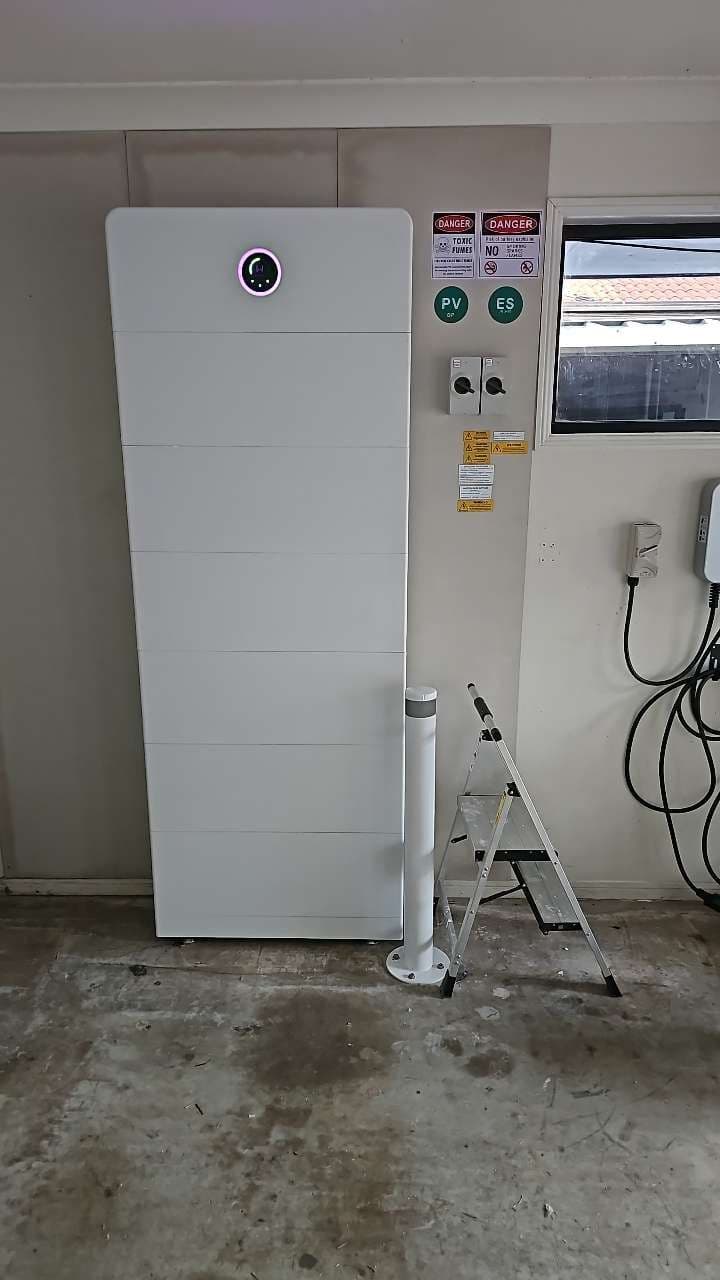
- Usable versus Nominal Capacity: When sizing, always specify usable capacity rather than gross cell capacity. A battery module rated at 5.12 kWh nominal typically yields 4.6 kWh usable energy under standard operating parameters.
Step 4: Solar Array Sizing for Winter Solstice
The most common design failure in amateur off-grid systems is sizing the solar array based on annual average sun hours or summer conditions. In Queensland, summer brings long daylight hours, high solar elevation, and abundant energy. However, off-grid systems must operate reliably in June and July during the winter solstice.
During mid-winter, the sun sits lower on the northern horizon, daily peak sun hours drop significantly, and the effective generation window narrows to between 9:00 AM and 3:00 PM.
To size your solar photovoltaic (PV) array correctly, apply this formula:
- Take your total daily consumption (e.g., 25 kWh).
- Add an overall system efficiency loss factor of fifteen percent (accounting for panel dust, inverter conversion efficiency, battery round-trip losses, and cable voltage drop). This increases the daily target to approximately 29 kWh.
- Divide by your local winter peak sun hours (typically 3.8 to 4.2 hours depending on your latitude in Queensland). Using 4.0 winter hours: 29 kWh divided by 4.0 hours yields a required array capacity of 7.25kW DC.
- Add a safety overhead margin of twenty to thirty percent to ensure the array can recharge batteries while simultaneously powering daytime household loads. A final array size of 9kW to 10kW DC guarantees reliable winter performance.
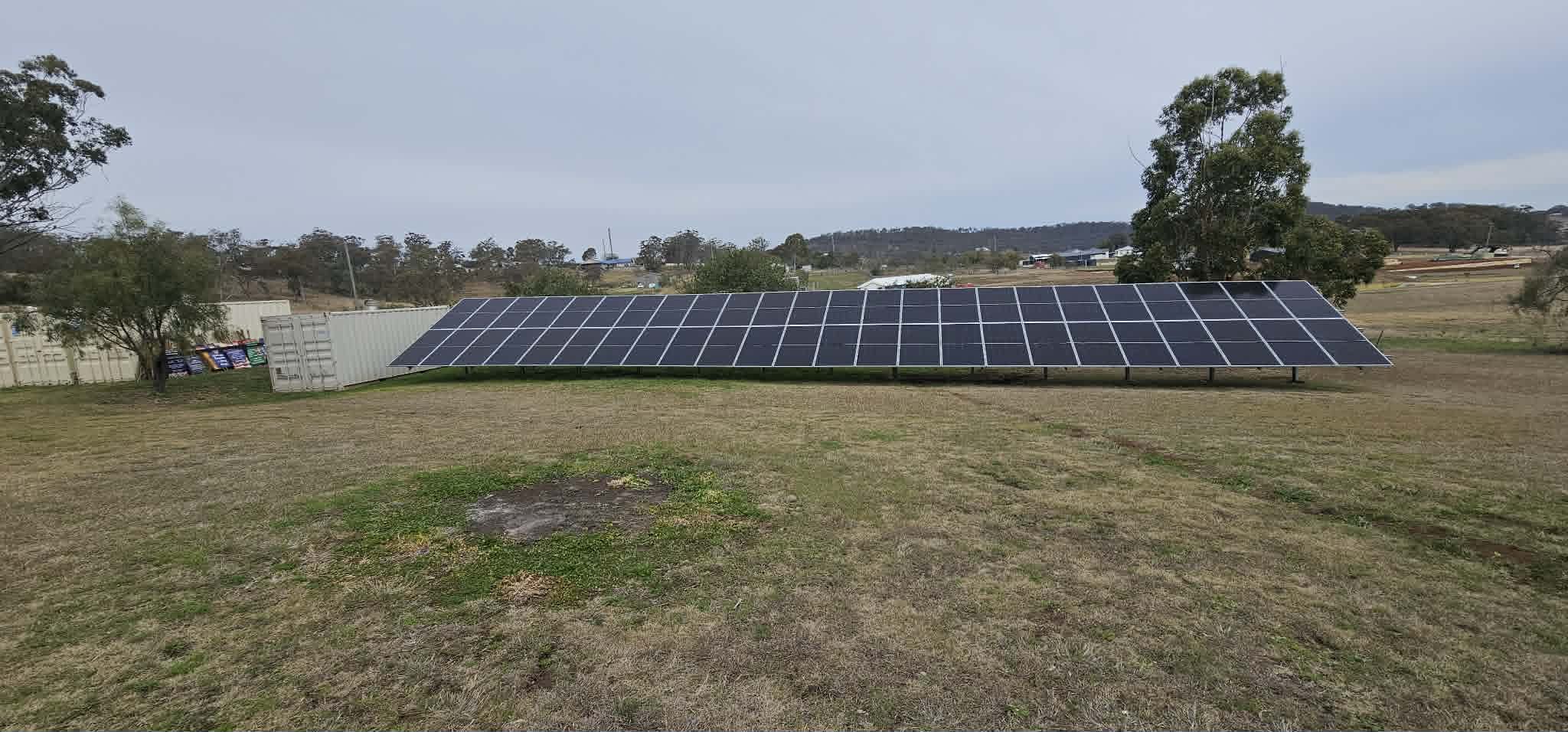
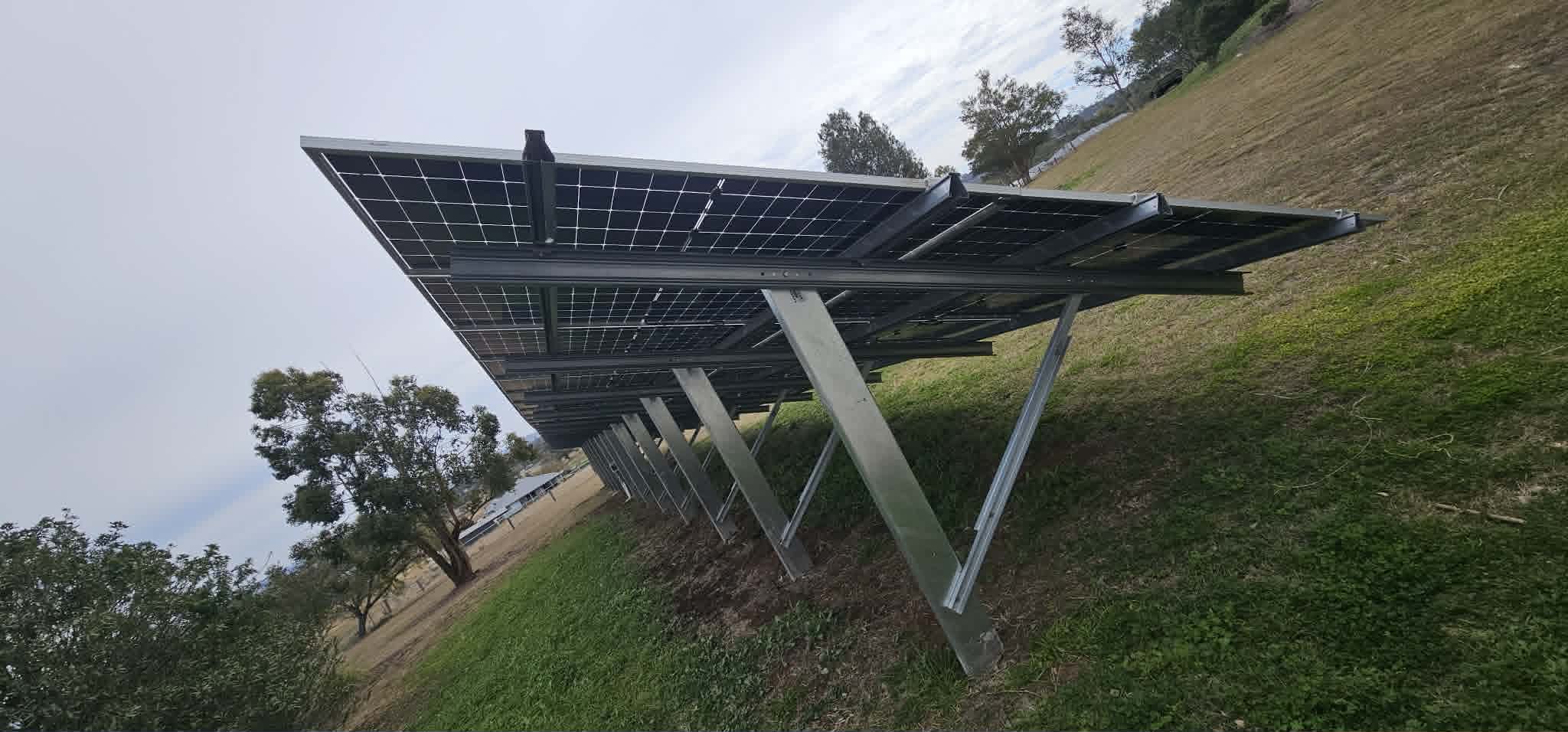
For rural ground-mounted arrays, installing panels on tilt frames adjusted to between thirty and thirty-five degrees perpendicular to the northern sky captures maximum winter sun, outperforming standard low-pitch tin shed roofs.
Integrating Auto-Start Generator Backup
An off-grid power system is incomplete without an integrated backup generator. Rather than viewing the generator as an emergency band-aid, professional electrical design incorporates the generator as a core system component.
A modern off-grid inverter-charger features built-in dry contact relays wired to a two-wire automatic start controller on a diesel generator. The inverter constantly monitors battery state of charge (SoC) and system voltage.
When three consecutive days of torrential rain deplete the battery bank to thirty percent state of charge, the inverter automatically signals the generator to crank, run through a warm-up cycle, synchronise frequency, and deliver high-amperage bulk charging power directly to the batteries while supplying household loads. Once the battery reaches eighty percent capacity, the inverter signals the generator to cool down and shut down automatically.
This hybrid design ensures your property never runs out of power, limits generator running hours to less than fifty hours per year, and saves tens of thousands of dollars compared to buying oversized battery banks.
At Handy Hands Electrical, our team designs custom stand-alone power systems to AS/NZS 4509, AS/NZS 5139, and AS/NZS 5033 standards. If you want your property sized accurately by licensed electricians who understand Queensland conditions, request an on-site design consultation today.
Boden Snell
QLD Licence 1503588Founder & Licensed Electrical Contractor
Boden has worked in the electrical trade for sixteen years, specialising in off-grid solar, battery storage, and stand-alone power systems for farms, commercial facilities, and island properties across Queensland.